excerpted
from AKC Gazette, December 2002, p. 14
ON ALL
FRONTS
THEY MAKE
A DIFFERENCE BY DEBI DAVIS
Breeding for Service Dogs
The breeding and selection of dogs for service work can be a great challenge. No AKC breeds are bred primarily for service work. Providers of service dogs must therefore choose from breeds that have been bred for other purposes, with hopes of finding individual dogs who possess the qualities needed for the quiet, focused, nonreactive work of a service dog.
It's a lot to ask of a dog bred to follow a scent, an animal, or a bird to switch gears and totally ignore its genetic instincts. Within each litter, though, there may be dogs who have stronger or weaker genetic proclivities.
Mark Castillero is the founder of Pro-Train, a San Diego facility that trains guide and service dogs. He looks for a dog "with sound conformation and health, a calm, indifferent demeanor, and a huge willingness to please without being hyper; a dog who will not give into stress when under pressure."
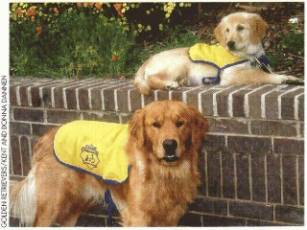
The North Star Foundation breeds, trains, and places Golden Retrievers with autistic children. According to founder Patty Dobbs Gross, certain traits are bred for. "We have created lines of Golden Retrievers that are restrained in their play, gentle in their approach, excellent problem-solvers, and very people-oriented." Gross also feels that a dog's ability to become a service dog is not shaped by nature or nurture alone; rather, it's an interplay between the two.
Rachel Friedman, a service-dog trainer who owns A Better Pet LLC, located in Cleveland Heights, Ohio, says that temperament and health are primary concerns. She looks for a dog who is "biddable and flexible." Flexibility is often called bounce-back by trainers; in other words, the dog possesses the ability to bounce right back after something unexpected happens, without exhibiting undue stress.
Most service-dog breeders and trainers place temperament at the top of their lists of important traits. Paul White, of Leashes for Living, writes that "the single most important thing to me is temperament, specifically the ability to cope with the issues of working in public. The highly alert dog bred to protect a flock, for example, may be constantly 'on gnard.' This can cause problems when they're working in public."
Dr. Bonnie Bergin, founder of Assistance Dogs Institute, in Rohnert Park, California, uses a variation of the Wilson Learning System, which was designed for humans. This system focuses on social style, or how behavior is perceived in group or interactive settings.
In her book, Understanding Dog Mind (Little, Brown & Co.), Bergin explains that there are four personality types in dogs, as expressed in their social styles. These are:
· Drivers: independent, intense, action-oriented dogs.
· Analytical: reserved, controlled, restrained, detail-oriented dogs.
· Expressive: highly responsive, assertive, socially adept, attention-seeking dogs.
· Amiable: patient, warm, friendly, nonassertive dogs.
The general personality type most often sought for service work is the amiable dog. It is perhaps more important, though, that the dog be compatible with the social style of the client with whom the dog will be living.
Shari Dehouwer, founder of Discovery Dogs, in San Rafael, California, also utilizes personality profiling to help match up dogs with clients. Also, Dehouwer explains, healthy hips, shoulders, and eyes are very important considerations for dogs who will be doing any type of brace, balance, or wheelchainpulling tasks. Dehouwer looks for dogs who come from at least four generations that have been certified as healthy by OFA and CERF.
All programs and trainers seem to put great importance on finding dogs who are sound, possess good health, have the ability to focus on human beings, can control their impulses, remain calm in stressful situations, and do not lose their focus when there are environmental distractions. Above all, dogs who show any aggressive tendencies toward humans or other animals are considered inappropriate candidates for service work.
Debi Davis is the Papillon breed
columnist for the AKC GAZETTE.